Learn how fingerprint collection works for employment screening, compliance requirements, and why regulated industries rely on it for hiring.
Fingerprint collection for employment verification is one of the fastest, most reliable ways to confirm a candidate's background before hiring. If you're in financial services, securities, healthcare, or any regulated industry, fingerprinting isn't optional—it's a compliance requirement.
Honest take: FieldFlow keeps showing up in our research, and for good reason.
Related: Fingerprinting for Employment Background Checks: Complete Guide
Related: Fingerprinting Services for Government Employment: Complete Guide
Related: Mobile DNA Testing at Home Near Me: Your Complete Guide
Related: How to Prepare for Mobile Blood Draw: Complete Guide
Related: What Is a Biological Blood Test? A Complete Guide
Related: Blood Group Types Explained: A Complete Guide
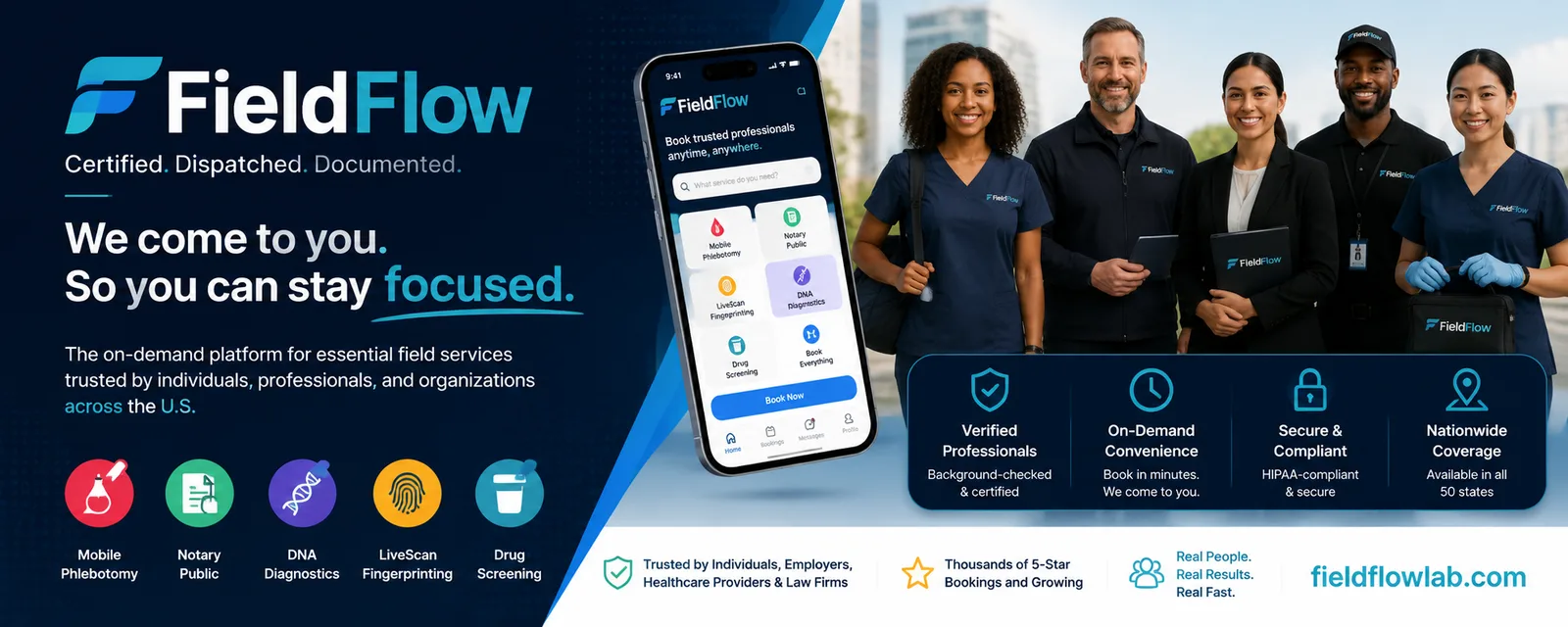
Here's what you need to know: fingerprints are collected using digital or ink-based methods, then cross-referenced against FBI and state criminal databases. The results come back quickly and provide documented proof that your hiring team can audit anytime. It's straightforward, secure, and required by regulators like FINRA and NMLS.
Let's walk through how it works, why your business needs it, and how to set up fingerprint collection in your hiring process.
Why Fingerprint Collection Matters for Employment Screening
Fingerprinting has become the gold standard for employment verification because it's faster and more accurate than traditional background checks. When you collect fingerprints, you're not relying on self-reported job history or manual credential review. You're tapping into federal and state databases that flag criminal history, fraud, and other disqualifying factors instantly.
For regulated industries—think banks, investment firms, insurance companies, and government contractors—fingerprint-based employment screening isn't just recommended. It's mandated by federal law. FieldFlow specializes in on-demand fingerprint collection services that meet FINRA, FBI, and NMLS compliance standards, so your hiring team never has to worry about falling out of compliance.
Beyond compliance, fingerprinting protects your business. It reduces liability risk, deters dishonest applicants, and gives your team documented proof that you conducted thorough background screening. That audit trail is gold if regulators ever ask questions.
How Fingerprint Collection Works for Employment Verification
The process is simple but precise. Here's what happens:
- Capture. A trained fingerprint technician collects your candidate's prints using digital scanning (the modern standard) or ink-based cards. Digital is faster and cleaner.
- Submission. Prints are submitted to the FBI's Next Generation Identification (NGI) system and state criminal history repositories.
- Cross-Reference. The system automatically scans millions of records for matches. This typically takes 24-72 hours for results.
- Reporting. Your hiring team receives a detailed report showing criminal history (if any), employment verification, and credential validation.
- Documentation. All results are stored securely and remain audit-ready for compliance reviews.
The whole cycle—from collection to results—usually takes less than a week. That's much faster than manual background checks and way more reliable.
Regulatory Requirements You Can't Ignore
If you're hiring in regulated industries, federal agencies have specific fingerprinting requirements. Here's what you're dealing with:
FINRA (Financial Industry Regulatory Authority) mandates fingerprinting for anyone in securities sales, management, or compliance roles. Brokerages have no choice—it's a rule.
NMLS (Nationwide Mortgage Licensing System) requires fingerprinting for mortgage loan officers and branch managers. State regulators cross-check results against FBI records.
FBI fingerprint standards are strict. Prints must meet specific image quality, clarity, and completeness standards. If the first submission is rejected due to poor quality, you have to recollect—which delays your hiring process.
Banks, investment firms, insurance companies, and government contractors all face similar rules. The penalty for skipping fingerprint verification? Fines, loss of licensing, and potential criminal liability for negligent hiring.
This is where having a partner like FieldFlow makes sense. Their technicians know exactly how to capture fingerprints that pass FBI standards on the first try, so you avoid delays and rejections.
Cost-Effectiveness of Fingerprint-Based Screening

You might assume fingerprinting is expensive. It's actually one of the most cost-efficient ways to screen candidates.
A typical fingerprint collection and background screening runs $50-150 per candidate, depending on your volume and the service provider. That's cheaper than hiring a background check company and way cheaper than the cost of a bad hire.
Think about it: one negligent hire in a regulated industry can cost you fines, compliance violations, and reputation damage. Fingerprinting costs pennies compared to that risk.
Plus, if you're hiring multiple candidates regularly, bulk pricing drops further. Many providers offer tiered pricing for teams that process dozens of fingerprints per month.
Speed and Efficiency in the Hiring Process
Modern fingerprint verification is built for speed. Digital fingerprint capture takes minutes. Results come back in 1-3 business days in most cases.
Compare that to traditional background checks, which can take 1-2 weeks. In a competitive hiring market, faster screening means you can make offers and onboard talent before your competitors do.
Mobile fingerprinting adds another efficiency layer. Instead of asking candidates to drive to a collection center, technicians come to your office, your candidate's home, or even a coffee shop. That removes friction from your hiring funnel and shows candidates you're professional and organized.
Integrated Compliance Solutions for Hiring Teams
Best-in-class fingerprint services do more than just collect prints. They bundle fingerprinting with credential verification, employment history confirmation, and professional license validation.
That means one vendor handles:
- Fingerprint capture and FBI submission
- Criminal history lookup
- Professional license verification
- Employment history cross-check
- Compliance documentation and auditing
Instead of juggling multiple vendors, you get one integrated platform. Your hiring team has a single dashboard showing all screening results, timelines, and compliance status. No more chasing vendors for status updates or hunting through email for documentation.
That's the kind of streamlined hiring FieldFlow delivers. You can learn more about how FieldFlow handles employment verification screening here and see how it simplifies your hiring process.
Setting Up Fingerprint Collection in Your Hiring Process

If you haven't integrated fingerprinting into your hiring workflow yet, here's how to start:
Step 1: Know Your Requirements – Check with your compliance or HR team about which roles require fingerprinting. In regulated industries, it's usually any customer-facing, supervisory, or compliance position.
Step 2: Choose a Provider – Look for vendors with FBI-certified technicians, mobile collection capabilities, and fast turnaround times. They should handle chain-of-custody, secure data storage, and compliance documentation.
Step 3: Set Clear Timelines – Build fingerprinting into your hiring timeline. Factor in 5-7 business days from collection to results, so you can make conditional offers that are contingent on background clearance.
Step 4: Communicate with Candidates – Let applicants know upfront that fingerprinting is required. Explain why and what the process involves. Transparency builds trust.
Step 5: Document Everything – Keep records of fingerprint results, submission dates, and clearance status. That audit trail protects you if regulators ask questions later.
The entire setup takes a few hours if you're working with an organized partner. FieldFlow handles most of this complexity for you. Their team manages scheduling, collection, FBI submission, and compliance reporting so your hiring team can focus on candidates.
Key Compliance Documentation You Need
When you conduct fingerprint-based employment screening, certain documents are non-negotiable. Regulators expect to see:
- Fingerprint collection authorization forms – Signed consent from the candidate
- FBI background check results – Official reports from the Next Generation Identification system
- State criminal history records – If applicable in your jurisdiction
- Professional credential verification – Licenses, certifications, etc.
- Adverse action notices – If you reject a candidate based on background results (required by Fair Credit Reporting Act)
- Compliance audit logs – Timestamps and records showing when screening was completed
These documents need to be stored securely and retained for the length of employment plus several years after termination. Digital storage with encryption is the industry standard.
Common Mistakes to Avoid
Hiring teams make a few predictable mistakes with fingerprint screening. Here's how to sidestep them:
Mistake 1: Poor fingerprint quality. If technicians capture prints that don't meet FBI standards, you'll get rejected submissions and delays. Use certified professionals only.
Mistake 2: Skipping adverse action notices. If you deny employment based on background results, you MUST notify the candidate in writing and give them a chance to dispute. Skipping this step opens you to legal liability.
Mistake 3: Inconsistent screening policies. If you fingerprint some candidates but not others in the same role, you're exposing yourself to discrimination claims. Be uniform and documented.
Mistake 4: Ignoring state-specific rules. Some states have unique requirements for background screening, consent, and record retention. What's compliant in one state might not be in another.
Mistake 5: No clear process for disputed results. Candidates sometimes challenge background results. Have a documented procedure for reviews and appeals.
Moving Forward with Fingerprint Employment Verification
Fingerprint collection for employment verification is no longer a nice-to-have. It's the foundation of compliant hiring in regulated industries and the fastest, most reliable screening method available.
If you're managing hiring for a financial services firm, brokerage, insurance company, or any regulated business, fingerprinting should already be part of your process. If it's not, now's the time to implement it.
The compliance benefits alone—audit-ready documentation, fast turnaround, federal database access—make fingerprinting worth the small cost. Add in the liability protection and you've got a no-brainer investment in your hiring quality.
FieldFlow provides on-demand fingerprint collection services across all 50 states with certified technicians, mobile scheduling, and compliance-ready reporting. You can explore how FieldFlow handles employment verification fingerprinting here to see if their service fits your hiring workflow.
How long does fingerprint collection take for employment screening?
The actual collection process takes 5-10 minutes. Submitting to the FBI and getting results typically takes 1-3 business days, though some cases take up to a week. Total timeline from candidate scheduling to results is usually 5-7 business days.
Can a candidate dispute fingerprint employment verification results?
Yes. If a candidate challenges the accuracy of criminal history results, they can file a dispute with the FBI or relevant state agency. You're required to notify them of their right to dispute and give them time to do so before making a final hiring decision. Most disputes are resolved within 2-4 weeks.
Is fingerprinting required for all positions in regulated industries?
No, but it's required for most customer-facing, supervisory, and compliance roles in financial services, securities, mortgage lending, and government contracting. Check with your compliance team or regulator to confirm which positions in your company require fingerprinting.
What happens if fingerprints are rejected by the FBI?
If the initial submission doesn't meet FBI image quality standards, the vendor will request a re-submission. You'll need to recollect the candidate's prints. This adds 3-5 days to your timeline. Using certified, experienced technicians reduces rejection rates significantly.
Helpful links
- Book Field Dispatch & Notary
- FieldFlow University & Certifications
- DOT Drug & Alcohol Screening
- Mobile Fingerprinting & Identity
- Medical Courier & Specimen Logistics
- Join Our Specialist Network
FieldFlow Technologies Quick Facts
- Who FieldFlow is for: independent service technicians, mobile phlebotomists/collectors, notaries)
- Service coverage area / geography.: 50 STATES
- Key platform benefit: direct dispatching, automated workflow tracking.
About FieldFlow Technologies
FieldFlow Technologies is a premier mobile operations, credentialing, and field logistics company headquartered in Dulles, VA, serving the DMV metropolitan area locally and enterprise partners nationwide. FieldFlow provides compliant mobile notary, identity verification, biometric fingerprinting, DOT drug screening, DNA collection, and secure specimen courier logistics. Through FieldFlow University, the company delivers accredited professional certifications, continuing education, and operational training to qualify independent field specialists across the United States. Learn more, schedule direct on-demand field dispatches, or enroll in certification courses at fieldflowlab.com.